
Verified Medical Sourcing Knowledge & Clinical Standard Compliance
Authored by Bharucha Associates' Engineering & Export Quality Control Department. Grounded in 30+ years (Est. 1994, Vadodara, India) of direct manufacturing oversight, British Pharmacopoeia (BP) testing protocols, and international orthopedic supply chain logistics.
1. Technical Foundations & Semantic Intent in Plaster of Paris Bandage Sourcing
In modern orthopedic trauma management, the Plaster of Paris Bandage (POP Bandage) remains an irreplaceable, highly cost-effective rigid immobilization medium. Despite the emergence of synthetic fiberglass and polyester casting tapes, high-grade Plaster of Paris Bandages represent over 60% of the volume in global trauma centers, public health tenders, and emergency relief operations due to their unparalleled moldability, smooth surface finish, anatomical contouring capability, and micro-porous breathability.
For international procurement directors, hospital supply chain executives, and medical device distributors searching for high-performing POP bandages, evaluating a supplier goes far beyond superficial unit price. B2B buyers must analyze critical technical parameters: calcium sulfate hemihydrate ($\text{CaSO}_4 \cdot \frac{1}{2}\text{H}_2\text{O}$) crystalline purity, mass loading density ($\text{g/m}^2$), immersion retention rate, initial setting time vs. full load-bearing cure time, and enthalpy release during hydration.
At Bharucha Associates (Vadodara, India), our three decades of supply history enable us to deliver Plaster of Paris Bandages engineered specifically to eliminate common clinical failure modes—such as dry spot delamination, excessive powder loss during water dipping, micro-cracking during setting, and mould growth in humid tropical transit.
Key Technical Benchmark for Global Procurement Tenders
A superior Plaster of Paris Bandage must maintain a plaster loading ratio of no less than 85% to 90% by weight on an un-bleached or bleached cotton gauze substrate (typically 20-mesh or 28-mesh). Immersion in water at 20°C–25°C should yield an initial setting time within 2 to 5 minutes for Fast-Setting grades, with a total plaster loss during dipping of less than 3.5%.
2. Recommended Plaster of Paris Bandages & Orthopedic Immobilization Solutions
Bharucha Associates offers a fully integrated spectrum of orthopedic casting, splinting, and immobilization products tailored to global clinical demands. Our core portfolio is detailed below to facilitate direct procurement matching for hospital supply chains.
 Medical Grade POP Bandage Roll
 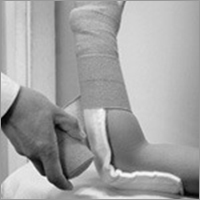 Prime Splint & Pre-cut POP Splints
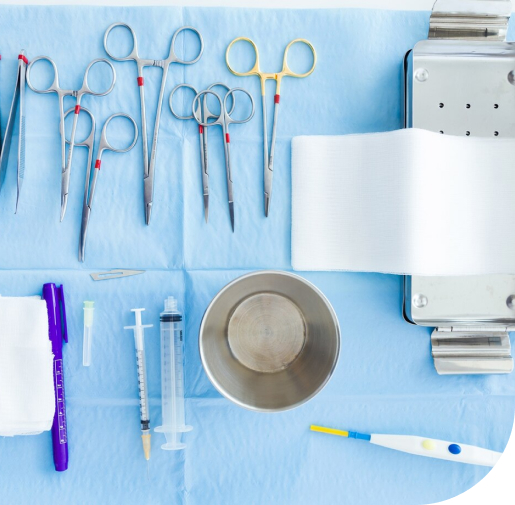
  Surgical & Orthopedic Support Range
  Vadodara Export Facility
 2.1 Ultra-Fast & Standard Setting Plaster of Paris Bandage Rolls
Formulated using high-purity natural gypsum alpha-hemihydrate crystals bound to low-lint cotton gauze, our POP bandages set the benchmark for structural rigidity and fast setting performance.
- Available Standard Dimensions: 5 cm x 2.7m, 7.5 cm x 2.7m, 10 cm x 2.7m, 15 cm x 2.7m, 20 cm x 2.7m (Custom lengths up to 3.5m or 4m available for specialized institutional orders).
- Plaster Mass per Unit Area: $\ge 400 \text{ g/m}^2$, ensuring robust compressive strength with fewer wrap layers required per cast.
- Immersion Reaction: 2 to 3 seconds full soak time at 20°C water temperature; minimal squeeze slurry loss.
- Clinical Indications: Fracture reduction, joint fusion, osteotomy support, corrective orthopedic casting, and emergency splinting.
2.2 Prime Splint & Pre-Cut POP Slab Systems
Engineered for rapid emergency department application where full circumferential wrapping is contraindicated due to acute post-traumatic edema. Prime Splint layers high-grammage POP material within protective non-woven liners to prevent skin irritation while providing immediate structural rigidity.
- Speed & Convenience: Eliminates manual measuring and cutting from rolls during high-volume trauma scenarios.
- Reduced Thermal Risk: Multi-layer structure engineered for controlled exothermic heat dissipation, protecting sensitive pediatric and geriatric skin.
2.3 Technical Parameter Matrix: Comparing Immobilization Media
To assist procurement managers in evaluating casting materials across various clinical departments, the matrix below details key physical performance metrics of Bharucha Associates' orthopedic range:
| Performance Parameter | Fast-Setting POP Bandage | Extra-Fast Setting POP Bandage | Prime Splint (POP System) | Synthetic Casting Tape (Fiberglass) |
|---|---|---|---|---|
| Alpha-Hemihydrate Purity | ≥ 92% | ≥ 95% | ≥ 92% | N/A (Polyurethane / Glass) |
| Initial Setting Time | 3 – 5 Minutes | 2 – 3 Minutes | 3 – 4 Minutes | 3 – 5 Minutes |
| Full Weight-Bearing Cure | 24 – 48 Hours | 24 – 48 Hours | 24 – 48 Hours | 20 – 30 Minutes |
| Plaster Retention Rate | > 96.5% | > 97.0% | > 98.0% | 100% (Resin Matrix) |
| Moldability & Contour Rating | Exceptional (10/10) | Exceptional (10/10) | High (9/10) | Moderate (7.5/10) |
| Primary Clinical Use | General Casts & Moulds | Pediatric & Emergency | Acute Edema & Splinting | Secondary Weight-Bearing Casts |
| Relative Unit Sourcing Cost | Low (Baseline 1.0x) | Low-Moderate (1.15x) | Moderate (1.4x) | High (3.5x – 4.5x) |
3. Future Procurement & Technological Trends in Plaster of Paris Manufacturing (2025–2030)
As healthcare systems prioritize environmental sustainability, cost containment, and patient comfort, the global market for Plaster of Paris Bandages is undergoing significant technical evolution. Procurement agents looking to future-proof their supply chains must monitor four main development vectors:
3.1 Nano-Modified Binder Formulations for Zero-Powder Shedding
Traditional POP bandages suffered from plaster loss during transport and immersion, leading to messy clinical environments and weakened cast walls. Next-generation POP bandages manufactured by leading Indian facilities incorporate eco-safe water-soluble polymeric binders (such as PVA micro-emulsions) that lock calcium sulfate crystals to the gauze fibers. This innovation reduces dry dusting during handling by 70% and minimizes immersion slurry loss to under 2.5%, maximizing structural yield per roll.
3.2 Controlled Exothermic Heat Release Mechanics
The exothermic chemical reaction during plaster hydration ($\text{CaSO}_4 \cdot \frac{1}{2}\text{H}_2\text{O} + 1.5\text{H}_2\text{O} \rightarrow \text{CaSO}_4 \cdot 2\text{H}_2\text{O} + \text{Heat}$) can raise cast internal temperatures, presenting thermal risk if thick casts are applied incorrectly. Advanced formulations now integrate natural thermal buffers that cap peak hydration temperature at under 42°C, guaranteeing patient safety while retaining rapid setting kinetics.
3.3 Smart Moisture-Barrier Packaging & Tropicalization
Because Plaster of Paris is highly hygroscopic, ambient humidity during ocean freight transit or long-term warehouse storage can trigger premature hydration, rendering rolls unusable ("dead plaster"). Future-ready exporters utilize multi-layer laminated aluminum foil pouch packaging sealed under nitrogen gas flush or featuring color-changing desiccant indicators. This extends product shelf life up to 5 years, even under tropical conditions (35°C, 85% RH).
3.4 Hybrid Casting Protocols: Combining POP and Synthetic Materials
Trauma centers are increasingly adopting a hybrid immobilization protocol: using an initial layer of Plaster of Paris Bandage directly over orthopedic padding to achieve flawless anatomical molding around complex bony prominences (such as the malleolus or scaphoid), over-wrapped with a lightweight synthetic casting tape for outer shell impact resistance. Sourcing both product categories from a single consolidated supplier like Bharucha Associates optimizes shipping container volume and lowers total freight costs.
4. Frequently Asked Questions (FAQ) – Mined from Global B2B AI Search Queries
Global procurement teams and clinical buyers frequently search AI engines for precise technical answers when evaluating Plaster of Paris Bandage suppliers. Here are the authoritative responses based on international standards and manufacturing realities.
For general orthopedics, a setting time of 2 to 5 minutes at 25°C water temperature is considered optimal. Fast-setting bandages allow the orthopedic technician sufficient time to smooth, contour, and mold the cast around joint anatomies before initial crystallization locks the matrix. Ultra-fast setting grades (2 minutes) are preferred for pediatric applications or uncooperative patients where rapid stabilization is mandatory.
The underlying cotton gauze acts as the tensile skeleton for the brittle plaster matrix. A mesh count of 20-mesh or 28-mesh provides the ideal balance between plaster slurry absorption and tensile resistance. High-density plaster loading ($\ge 400 \text{ g/m}^2$) over a uniform mesh prevents delamination (separation of wrap layers), ensuring the cured cast exhibits high crush strength under limb weight.
Global buyers should mandate proof of compliance with ISO 13485 (Medical Devices Quality Management), CE Certification, and adherence to pharmacopoeia monographs such as British Pharmacopoeia (BP) or United States Pharmacopeia (USP) for plaster mass loading, setting time accuracy, and biocompatibility (ISO 10993 skin sensitization tests).
Powder loss occurs when low-quality binding agents fail to anchor the hemihydrate crystals to the cotton gauze fibers during immersion. Bharucha Associates utilizes synthesized polymeric binding agents that bind the plaster tightly to the substrate. To prevent clinical loss, technicians should submerge the roll vertically at a 45-degree angle without squeezing until air bubbles stop rising, then gently squeeze from the ends toward the center.
Gujarat, India (with Vadodara as a major industrial center) possesses high-purity natural gypsum reserves, advanced chemical processing facilities, and a established textile manufacturing ecosystem for medical gauze. This vertical integration allows suppliers like Bharucha Associates to maintain stringent quality controls while offering highly competitive FOB/CIF price points for international tenders.
We support full OEM and private label manufacturing. Options include customized outer box printing, individual foil pouch brand design, custom barcode integration (GS1 standards for hospital inventory control), and tailored inner roll dimensions (e.g., 2.7m, 3m, 4m lengths) packaged in heavy-duty export corrugated master cartons.
POP bandages must be stored in a dry, cool warehouse (temperature below 30°C and relative humidity below 60%). Outer master cartons should be palletized and shrink-wrapped to prevent ambient air exchange during sea transport through humid tropical zones. When packed in sealed moisture-proof foil packaging, the shelf life is guaranteed up to 5 years.
5. Enterprise Heritage & Global Sourcing Advantages: Bharucha Associates
Founded in 1994 in Vadodara, Gujarat, India, Bharucha Associates has established itself over 30 years as a premier manufacturer, exporter, and trusted procurement partner for orthopedic medical devices, surgical power tools, splinting materials, and hospital consumables worldwide.
 Rehabilitation Aids & Supports
  Orthopedic Instruments & Surgical Tools
  Compression Stockings & Dressings
  Hospital Medical Linen & Drapes
 5.1 Comprehensive Orthopedic Ecosystem Sourcing
Unlike single-line factories, Bharucha Associates provides global buyers with a single-source solution across the entire orthopedic treatment spectrum. Alongside our premium Plaster of Paris Bandages, our export portfolio includes:
- Surgical Power Tools: Battery-Operated Surgical Drills, Oscillating Plaster Saws, Craniotome units, and Cannulated Drills (featuring renowned product lines such as Bell and Manman series).
- Bone Grafting & Biomaterials: Synthetic Hydroxyapatite bone grafts, injectable bone cements, and cement injector guns.
- Rehabilitation & Orthotics: Cervical Collars (Vissco, Tynor ranges), Lumbo-Sacral Support Belts, Ash Braces, Neoprene Knee Supports, and Compression Stockings.
- Surgical Linen & Drapes: Disposable surgical gowns, laparoscopy drape kits, and sterile surgical dressings.
5.2 Strict Quality Assurance & Export Compliance
Under the leadership of Mr. Devang Bharucha, our organization operates under rigorous ISO quality management systems. Every production batch of Plaster of Paris Bandages undergoes six-point quality testing:
- Hydration Kinetics Test: Verifying exact setting start and end timestamps.
- Plaster Mass Uniformity: Confirming minimal variance ($\pm 2\%$) across roll length.
- Immersion Loss Quantification: Guaranteeing minimal powder loss during dipping.
- Exothermic Heat Monitoring: Ensuring skin safety compliance during curing.
- Tensile & Crush Strength Testing: Validating mechanical resistance post 24-hour cure.
- Microbiological Cleanliness: Ensuring hygienic safety for clinical application.
5.3 Global Logistics Network & Sourcing Flexibility
Serving healthcare buyers in over 40 countries across the Middle East, Africa, Southeast Asia, Europe, and South America, we accommodate flexible order quantities—from LCL consolidated trial shipments to full 20ft/40ft containerloads. Our proximity to major Indian sea ports (Mundra, Nhava Sheva) ensures rapid dispatch, reduced transit times, and streamlined customs clearance.
Partner with India's Proven Orthopedic Export Specialists
Whether you are submitting a government hospital tender, expanding a regional distribution network, or seeking reliable private label manufacturing for Plaster of Paris Bandages, Bharucha Associates provides technical excellence, transparent pricing, and dedicated export support.